




April 8, 2025
Shipping tariffs: Meaning, costs, and actions for US retailers
Explore tariffs’ meaning, costs, and what retailers can do. Get US-specific insights on...
Read now
For the complete documentation index, see llms.txt.
Published: 2026-01-30
Written by Kimberley Hughes
Summary: US shipping without disruptions depends on clean product data, accurate HS or HTS codes, origin details, duties handling and clear customer costs. Review customs data and carrier processes before dispatch so parcels keep moving as US import requirements tighten in 2026.
For years, shipping to the United States felt like sending parcels across state lines. A generous de minimis threshold meant most orders cleared customs quietly, with little friction for retailers.
As Justin Irvine of The Aggregate Co. noted during a recent Starshipit webinar, that sense of familiarity influenced many brands to approach the US market as if it operated more like domestic distribution rather than true international trade. Unfortunately, recent policy shifts have changed that reality. Operationally and commercially, the US now resembles the UK and EU, where compliance, data quality, and duty handling sit firmly in the foreground of every shipment.
Rather than rehashing what tariffs are or how de minimis works, this article takes a different approach. For a full breakdown of policy changes and cost implications, start with our comprehensive US tariffs guide for retailers.
The focus here is practical. In the sections ahead, we look at what retailers need to put in place right now to keep US-bound parcels moving, keep customers informed, and keep shipping workflows running under the new rules.
The biggest shift facing retailers shipping to the United States is practical rather than theoretical. Policy changes have moved duty handling, product data, and compliance checks into the centre of everyday shipping workflows. Every US-bound parcel now needs clear decisions and accurate information before it ever leaves the warehouse.
Low-value shipments that once moved freely now require duty calculation and proof of payment as part of the outbound process. Even modest orders can trigger tariffs, which means carriers need confirmation that duties will be settled upfront.
Postal operators and couriers have reacted fast. Australia Post, New Zealand Post, and other networks have introduced new checks that verify duty arrangements before parcels depart. Retailers without the right setup risk seeing shipments stopped early in the journey.
Operationally, the timing has flipped. Duty handling and data validation must occur before label creation, rather than being handled later or passed on to the customer at delivery.
Prior to dispatch, shipping systems, checkout flows, and carrier configurations must all align. Preparation at origin now separates smooth delivery experiences from parcels that never leave the country.
Hope for a quick return to the old model is understandable, yet unlikely. As Morgan Hardy from Indirect Tax Solutions has explained in our recent webinar, strong political incentives sit behind the current tariff framework.
Rolling back duties or reinstating generous de minimis thresholds would be difficult to defend publicly, particularly in the context of domestic manufacturing and trade policy.
Executive orders give the US administration flexibility to adjust tactics, even if individual measures face legal challenges. Alternative mechanisms can be introduced to reach similar outcomes, which limits the chance of a full reversal.
Retailers should look at this as their new normal, so long-term thinking matters here. Retailers are better served by building repeatable, durable shipping processes that account for duties and compliance as standard practice, rather than waiting for conditions to soften.
Now that every US-bound parcel faces scrutiny, data quality moves to the centre of day-to-day shipping operations. Customs authorities, carriers, and postal networks now rely on accurate product and shipment information before goods even leave origin.
Practical execution matters far more than theory here. Retailers that treat data as part of the shipping workflow, rather than an afterthought, place themselves in a far stronger position to keep parcels moving.
Most retailers already understand what HS and HTS codes are and why they exist. For anyone wanting a refresher on definitions or tariff structure, our US tariffs guide and HS code explainer cover that ground. The challenge today isn’t understanding the codes, it’s applying them consistently as product ranges grow and shipping volumes increase.
At scale, classification stops being a one-off task and becomes a workflow problem. Manual entry might work for a small catalogue, but it quickly breaks down once ranges stretch into the hundreds or thousands of SKUs. Inconsistent data, duplicate entry, and one-off fixes introduce errors that can lead to delays or unexpected duty charges at the border.
The most reliable starting point is using the product data retailers already maintain. HS codes can be stored against products in eCommerce platforms or PIMs and passed through to fulfilment and customs documentation automatically. Starshipit’s core platform supports this by pulling HS codes through with orders, helping keep merchandising, fulfilment, and customs aligned without re-entering information at the shipping stage.
Automation helps close the remaining gaps. Rules can be used to apply HS codes across predictable product ranges, while defaults act as a safety net when data is missing, reducing the risk of shipments being held up. Clear, detailed product descriptions remain critical, giving both systems and customs authorities the context they need to apply the correct classification.
Once HS codes and origin data are in place, Starshipit’s Landed Cost Solution builds on that foundation by calculating duties and taxes upfront, using accurate product data to show true landed costs before parcels reach US customs. Together, these processes reduce manual effort, improve consistency, and help retailers scale US shipping with far less risk.
Getting HS codes right is about building repeatable, reliable processes that scale with the business and support accurate duty and tax calculations as volumes grow.
Beyond classification, US Customs and Border Protection increasingly prioritizes the location and manufacturer of goods.
Manufacturer Identification codes, often referred to as MID codes, act as identifiers tied to the factory or producer of a product. As Justin Irvine has explained, CBP uses these codes to track manufacturing sources and spot higher-risk supply chains.
Advanced AI-driven anomaly detection now scans shipment data for inconsistencies across origin, value, and historical patterns. Sudden changes in declared manufacturing locations or unusually low values are far more likely to surface for review than in the past. Shortcuts such as fictional origins or understated values create long-term exposure for brands, even if shipments slip through initially.
Country-of-origin declarations deserve similar care. Origin depends on where a product undergoes a substantial transformation, not where finishing touches occur.
Hakan offered a simple illustration: fabric imported into Australia and turned into finished shirts can legitimately be declared as Australian-made. Shirts that are imported fully assembled and altered with minor additions cannot be processed.
Reliable origin information helps brands avoid audit complications, prevent shipment delays, and reduce the risk of damage to their reputation. Clean data acts as a risk management tool, supporting smoother clearance and more predictable delivery outcomes
Postal shipping has seen some of the fastest operational changes since US duty rules tightened. Understanding how duties are handled within postal flows helps avoid stalled shipments and unexpected returns.
Postal operators in Australia and New Zealand have adopted different duty-handling models, even though the outcome is similar. Duties must be settled before parcels head to the United States. Waseem from Zonos outlined how New Zealand Post approaches the process.
NZ Post directly bills merchants for duties associated with US-bound shipments. Retailers will need a Zonos account which sits behind the scenes, billing NZ Post and remitting the collected duties to US Customs and Border Protection on their behalf. Retailers see a single charge from NZ Post, while the compliance work happens upstream.
Australia Post has taken a slightly different path. To bill duties straight to the retailer, merchants shipping to the US must go through a verified Zonos account before orders are processed.
Australia Post checks that a valid duty-payment arrangement is in place before any parcels proceed. Without that link, parcels are unlikely to leave the country and could be returned to the sender early in the process.
Operational clarity around PDDP versus DDP helps here. Postal Delivered Duties Paid, often shortened to PDDP, simply means the sender pays all duties through the postal system rather than leaving charges for the recipient. Day-to-day, PDDP works much like DDP with courier services.
Duties are handled upfront, customers avoid surprise fees, and parcels clear customs more smoothly. Retailers using postal services now need PDDP-style setups as standard practice for US shipments.
Zonos plays a central role in the new postal landscape as one of the qualified entities approved to remit duties to US authorities. Its platform supports classification, duty calculation, and collection, which postal operators and merchants rely on to meet compliance requirements at scale.
Starshipit builds on that foundation through its end-to-end Landed Costs Solution. Retailers using this flow do not need to manage a separate Zonos account for postal shipments. Duties, taxes, and shipping charges roll into a single Starshipit bill, with calculations handled automatically and discrepancies managed behind the scenes.
Postal duty changes have caused widespread confusion, particularly for merchants used to simpler workflows. Clear tooling and integrated processes remove much of that uncertainty and help retailers ship to the US with greater confidence.
Pricing decisions have moved well beyond margin management for US shipments. Duty handling now intersects directly with how prices are presented to customers and how values flow through to customs declarations.
Small configuration gaps can create unnecessary cost exposure, even when the initial intentions are right. A clear pricing approach paired with the right systems helps prevent that outcome.
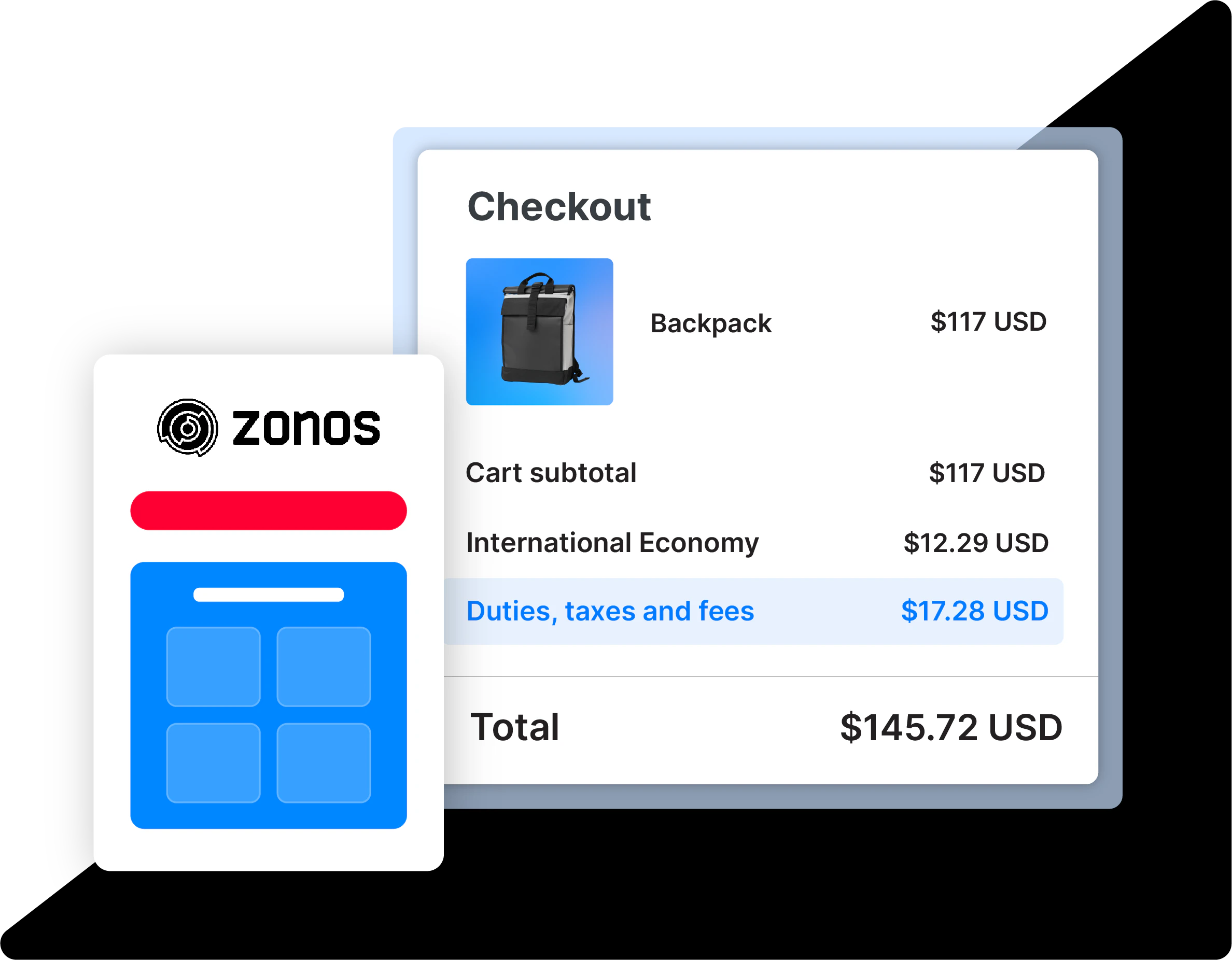
Retailers generally land on one of two approaches. Duties can appear as a separate line item at checkout, aligning with the traditional Delivered Duties Paid model.
Customers see import charges up front, pay them at purchase, and receive parcels without payment requests at delivery. Transparency sits front and centre, though checkout totals can feel heavier.
Other brands prefer to fold duties into product pricing or shipping rates. Customers perceive a single, comprehensive price and enjoy a simplified checkout process, where the seller's coverage of import charges is evident. Conversion rates often benefit when surprises disappear, especially for repeat customers.
Problems arise when duty-inclusive pricing is handled incorrectly behind the scenes. Justin Irvine described seeing retailers increase product prices to cover duties, then accidentally declare that inflated price to customs.
Customs authorities calculate tariffs based on the declared value, so duties are applied to an amount that already includes duty. The result is paying tariffs on top of tariffs.
Avoiding that trap requires alignment between pricing strategy and customs data. The terms and conditions should make it clear that the prices include duties that the customer has already paid. Landed cost tools need to separate the duty portion from the product value when generating customs declarations.
Early reactions to the new US shipping landscape have varied widely. Morgan Hardy has noted that some brands have chosen to pause US shipping altogether, at least in the short term. For businesses with limited US demand or tight margins, stepping back can feel safer than absorbing new costs or reworking systems under pressure.
Other retailers are testing different operational responses. Some are reassessing sourcing, looking beyond China in hopes of reducing tariff exposure on certain product categories.
Others are investigating fulfilment options inside the United States or in nearby markets such as Canada or Mexico, where goods can be imported in bulk before being distributed locally. A third group is experimenting with drop-ship models or offshore fulfilment partners that ship directly to US customers on their behalf.
If you’re growing US sales or changing where you hold stock, review state sales-tax obligations alongside your fulfilment plans. These are separate from import duties. TaxCloud’s state-by-state economic nexus guide outlines sales-based thresholds; a tax adviser can assess how your sales and stock locations affect your obligations.
Each approach carries trade-offs, and none is free of risk. Supply chain changes take time and investment, while offshore fulfilment introduces new dependencies and compliance considerations. Drop-ship arrangements particularly require expert caution.
If a supplier under-declares values or misclassifies goods to move parcels faster, US Customs and Border Protection will eventually connect those patterns back to the brand behind the shipment.
Short-term cost savings can look attractive, yet they may undermine long-term access to the US market. Observing how peers are responding can be valuable, but sustainable outcomes tend to come from transparent processes, accurate data, and shipping models that stand up to ongoing scrutiny rather than quick workarounds.
Daily shipping to the United States now benefits from a clear, repeatable checklist that teams can follow before parcels leave the warehouse.
Product records should already include HS or HTS codes that have been carefully reviewed for accuracy. The country of origin needs to reflect where the substantial transformation actually occurs, and manufacturer identification codes should point to the correct factory or producer. Clean data at this stage reduces friction later in the journey.
A clear decision on pricing presentation should already be in place, with either duties shown at checkout or baked into pricing. Duty collection and remittance methods need to match that decision. Retailers using Starshipit’s landed cost solution can rely on automated separation of product value and duty amounts, which supports smoother customs declarations.
Postal shipments heading to the US must link to an approved duties arrangement before dispatch. Australia Post and New Zealand Post both verify this step early. Parcels missing that connection risk being returned before leaving origin, which disrupts fulfilment and customer expectations.
Per-shipment fees charged by carriers or postal networks deserve regular review. Spot-checking invoices against expected charges helps avoid quiet cost creep. Pricing models should reflect these fees rather than absorbing surprises later.
Advanced structures such as first-sale valuation, B2B2C models, or transfer pricing deserve specialist input. Brands should involve tax professionals early, particularly when multiple entities or jurisdictions sit within the transaction flow.
Expert support at that stage helps companies navigate requirements correctly and maintain long-term, reliable access to the US market.
At Starshipit, we built our US shipping workflows to match the reality retailers face today. Our Landed Costs Solution is powered by Zonos, bringing duty calculation and remittance into the same place you already manage labels, carriers, and fulfilment. Everything runs through a single workflow, with one consolidated bill and fewer moving parts for your team to manage.
Product data can be stored and passed at scale, including HS codes, MID codes, and country of origin, so customs information flows correctly every time a parcel ships. That setup reduces interruptions, cuts down rework, and keeps orders moving once they leave your warehouse.
If US shipping feels heavier than it used to, now’s a good time to take a closer look. Talk to our team about configuring US shipping correctly, book a demo to see how our landed cost solution works in practice, or start a free trial to test it with your own orders.
Teams that want even more context for today’s article can also watch the full webinar and hear directly how retailers are adapting to the shifting shipping environment.
Kimberley Hughes
More from this author