

George Plummer
CEO, Starshipit

For the complete documentation index, see llms.txt.
Evolving Expectations 2023 benchmarks the fulfilment trends shaping delivery speed, transparency, cost control and post-purchase experience. Use the report to compare your shipping maturity, spot operational gaps and plan practical improvements across carriers, returns, data and customer communication with less guesswork.
Welcome to Evolving Expectations: A Look into the Future of eCommerce Shipping, an exploration of the shipping trends that we expect to see play out this year – and beyond.
We’ve spoken to leading retailers from Australia, New Zealand and around the world to learn what they’re going to prioritise in order to remain competitive and grow their businesses.
The last few years have presented unique challenges to the retail industry as a result of the exponential growth of eCommerce, amplified by the unprecedented global pandemic. The significant shift in consumer behaviour towards online purchasing has redefined the retail landscape.
The current economic landscape may require greater effort to achieve the high notes of previous years, but the undeniable reality remains - eCommerce has firmly established itself as the preferred mode of shopping for consumers globally. This is validated by the staggering statistic that 90.4% of internet users regularly visit online retail stores, and the projected growth of retail spending in Australia, which is predicted to reach AUD$49 billion by 2025.
In 2022, we saw customer expectations continue to change around the delivery experience. To get some insight, we asked our customers how important it was for them to represent their brand throughout the post-purchase/delivery experience, and nearly all our respondents ranked it as a top priority.
Behind the scenes, businesses now need to look at the systems underpinning their shipping operations to ensure they’re both robust enough and cost-effective.
We are seeing retailers start to focus on their operating performance and costs due to the current economic climate.
Key areas to review this year include:
My advice to retailers is simple: Effective cost control measures – especially with regards to shipping – not only enhance your bottom line but also provide you with a competitive edge, enabling you to allocate resources more strategically and make informed business decisions.
I hope retailers will be able to use the insights in this report to guide their shipping strategies and, most importantly, deliver better shipping experiences for their customers.
Shipping continues to evolve. The days of a template order confirmation email and little to no contact throughout the delivery experience no longer cut it. Now more than ever, your customers expect more after they click “buy now”.
Shipping is one of the costliest parts of running a business – and it plays a substantial role in your bottom line. Bad deliveries are expensive. Good business means a solid shipping strategy underpinned with the right technology. The result? The ability to keep orders moving out the door and customers happy.
Here’s a quick overview of the trends you’ll read about in this report:
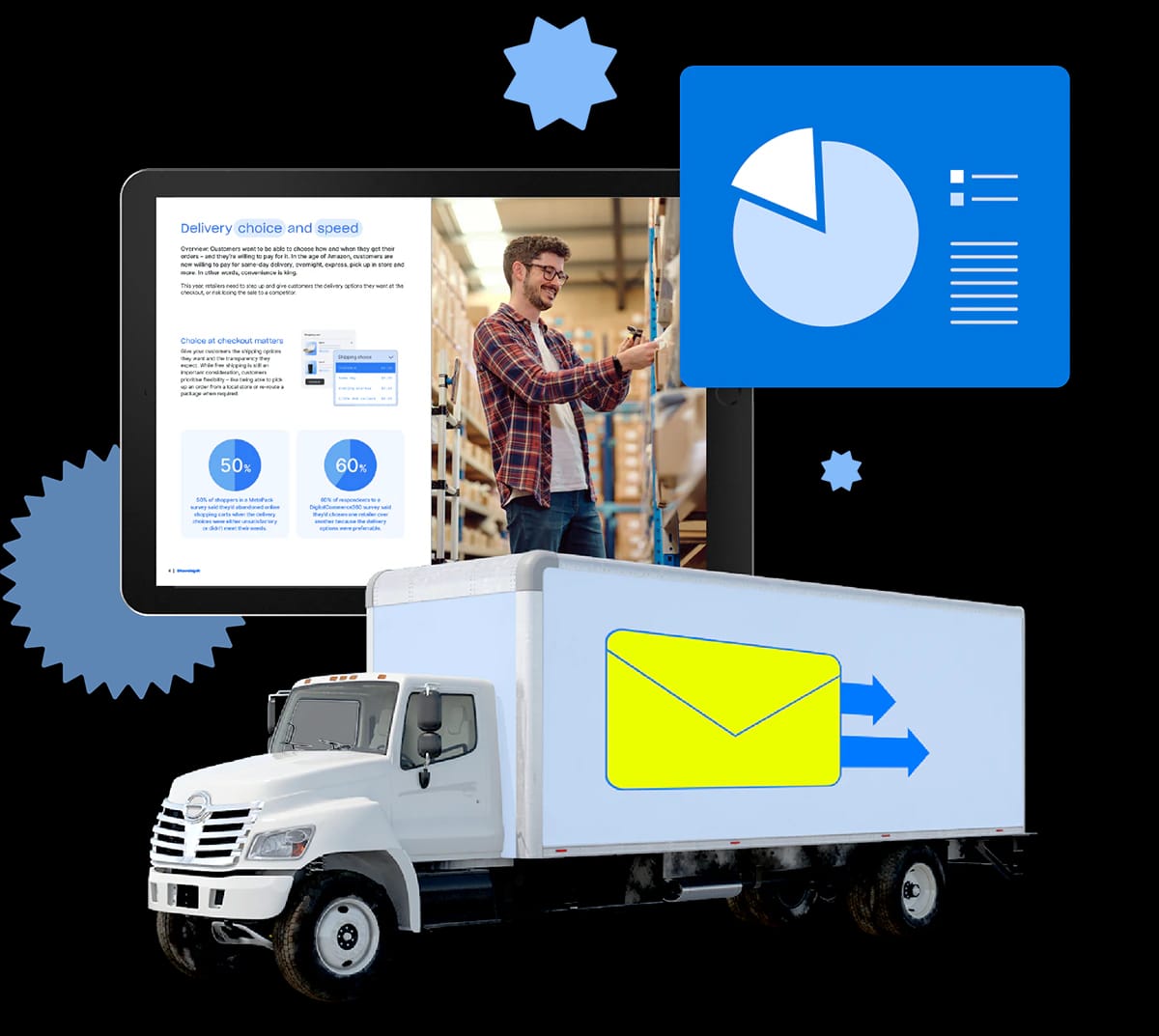
Delivery choice and speed matter to your customers. They want choice at the checkout – choice of delivery methods and timeframes – think same day, express, pick-up in store etc. In one survey, 50% of buyers said they’d abandoned an online shopping cart when they weren’t happy with the delivery choices available. The solution is simple; give customers the options they want at checkout.
The other side of this coin is customer visibility. Your customers want transparency around delivery times. They want to know when they’ll get their orders with a high degree of accuracy. This means you’ll need to keep your customers updated at various stages throughout post purchase – which means sending more than one notification to say your order has been delivered and providing detailed branded tracking pages with order status information, contact details and more.
When it comes to the operational side of shipping, retailers should use their brick-and-mortar footprint to deploy faster (and cheaper) shipping options using a ship-from-store strategy. There are other benefits, too. By unifying your stock pool, you’ll be able to get orders to customers quicker and implement same-day delivery strategies. You can also utilise stock across your retail stores and warehouses more effectively.
Despite the disruptions in 2022 (including the Western Australian fires), many businesses continue to rely on a single courier. Multi-courier strategies offer an effective solution, allowing you to pick and choose the right courier for each order, remove couriers that aren’t performing and add new services when required.
To scale their businesses, retailers will want to look at international shipping. Supporting international deliveries can open entirely new markets, which in turn can bring significant growth. While it can seem daunting at first, automation has a large part to play in eliminating repeatable tasks like customs paperwork, HS codes and more.
Basing your shipping decisions on data can yield impressive results. By understanding how your couriers are performing, you can make changes and improve your delivery experience. In turn, you’ll also be able to reduce waste and save time. The right tools have a large part to play here. Shipping software (with analytics) can make understanding your data much simpler, giving you easy-to-understand overviews of how your shipping is performing.
Naturally, sustainability continues to be a top priority for retailers and customers alike. In fact, one survey found that 3 in 4 Australians consider at least some element of sustainability when they buy online.
And what about when customers want to reverse course and return a product? One study found that returns have risen recently to nearly 17% of all orders! In other words, no matter how good your products, branding or shipping services are, some customers will return their orders every now and again. Thankfully, that’s not always bad news. There’s a lot you can do to streamline the process for your customers and transform returns into an opportunity.
This is set to be another year of change for retailers. Those businesses that make meaningful adjustments will stand to reap the rewards – healthier bottom lines, efficient shipping and delivery operations, and happy customers.
Overview: Customers want to be able to choose how and when they get their orders – and they’re willing to pay for it. In the age of Amazon, customers now expect same-day delivery, overnight, express, pick-up in store and more. In other words, convenience is king.
This year, retailers need to step up and give customers the delivery options they want at the checkout, or risk losing the sale to a competitor.
Give your customers the shipping options they want and the transparency they expect. While free shipping is still an important consideration, customers tend to prioritise flexibility – like being able to pick up an order from a local store or reroute a package when required.
Customers primarily want choice, but delivery speed in particular ranks as a top motivator for customers. While customers will always love to see a free shipping option, they’re willing to pay for speed. One study found that 23% of orders placed online used two-day shipping.
Overview: The excitement customers feel when a package is on the way can quickly turn to frustration if the initial delivery timeline isn’t met. Despite your best efforts, global shipping issues can make prompt delivery timelines a real issue.
Keep customers informed and you’ll keep them loyal. Customers love knowing when an item has left your store and is on the way to them. Finding ways to keep customers in the loop is not just a way to meet expectations, it’s a chance to communicate and build connections to engage with customers and build loyalty.
Shipping delays are usually always unexpected and come out of nowhere. They’re also caused by a variety of factors, for example courier mistakes, strikes and human error.
In 2021, nearly all members of the National Retail Federation of the USA were impacted by shipping delays. It’s been a tough couple of years for eCommerce businesses worldwide, and this uncertainty can make it difficult for your business to provide accurate delivery times to customers.
Overview: Supply chain issues, inflation and a possible recession aren’t making things easy for businesses. In 2023, eCommerce retailers still expect to feel the effects of these disruptions and will need to focus on finding ways to control costs.
In particular, businesses will pay close attention to shipping overheads in terms of shipping rates and pricing approaches (free shipping).
Recession expectations and a need to combat inflation will force businesses of all sizes to adapt and make considered choices with regards to spending. Rising inflation means a need to revise approaches to pricing, sourcing materials and operational costs.
One survey found that 83% of midsize businesses have passed at least some cost increases onto consumers, and 68% of small businesses have raised prices on certain products and services. Meanwhile, 94% of small businesses stated that inflation has impacted expenses.
Shipping is an unavoidable cost for retailers – but they do have control over just how big a piece of the pie shipping will be. According to American Express, shipping ranks as a top expense alongside returns and refunds, platform fees and sourcing products for eCommerce businesses. So what can businesses do?
Shipping as a category can be broken down into a variety of different expenses, but it’s the rates charged by carriers that will eat up the majority of spend. For businesses, negotiating rates directly with carriers is one of the best ways to control costs, as opposed to using aggregators which provide set rates.
Automation is another way to control shipping spend. Retailers can set up business logic using automation, choose the cheapest courier for an order every time and eliminate repeatable manual tasks like generating shipping labels, fixing incorrect addresses and filling out customer documentation.
Businesses can also unlock significant time savings in their shipping processes through automation. For example, Australian brewery Mountain Culture was able to save 6-10 hours per week on packing and logistics alone after implementing an automated shipping solution.
While shipping acumen has always been important, it’s now crucial for most companies.
76% of retailers prefer to negotiate their own courier rates instead of using courier aggregator services. It’s easy to see why. Instead of having little to no control over courier costs, retailers can negotiate with their couriers directly and keep a handle on costs as their business grows.
Do you prefer to manage your own relationships with your couriers or use a third-party service?
Overview: Ship from store is a growing trend that we’re seeing more and more retailers adopt as it is one of the best strategies to leverage brick-and-mortar stores for quicker and cheaper shipping.
Ship from store is a shipping model where businesses use inventory held in physical stores to fulfil sales from their eCommerce channels.
Here’s why retailers are choosing to implement ship from store strategies. While sustainability and costs rank as high considerations, it’s speeding up customer delivery timeframes that makes this an attractive model for retailers.
Ship from store: What you need to know. This unique shipping model is growing in popularity due to two related factors: An expanding eCommerce market (it’s forecast to make up 24.5 percent of the total retail sales market by 2025) and traditional brick and mortar stores continuing to prove a popular option for customers.
Keep freight costs down: Shipping from store is a great way to combat rising freight costs if you have a network of stores, but don’t have multiple fulfilment centres.
Improve inventory turnover and reduce deadstock: Fulfilling online orders using retail stock means higher inventory turnover (less aging stock). It also helps you to avoid the issue of deadstock.
Increase delivery speed: Ship from store can improve your delivery speed and help you achieve faster delivery timeframes (like same-day delivery).
Reduce cart abandonment: Free shipping (and shorter shipping timeframes) can have a big impact on reducing cart abandonment. Using the ship from store model can help you to more easily meet these timeframes.
Small retailers often find the ship from store model useful as they won’t typically have a distribution centre, instead using a few retail stores to ship from store.
In a nutshell, you should ship from store based on the following calculation:
Inventory management – When you introduce inventory held in stores alongside inventory held in a central warehouse or distribution centre, but you’re selling it through the same online channels, you will need to think about how you manage your inventory. Some eCommerce platforms (like Shopify) provide multi-location functionality out of the box, which provide simple inventory management across multiple locations.
When and how to ship orders – If a customer orders a coffee cup and an espresso machine, you’ll need to determine the most cost-effective way to fulfil those orders.
Overview: There’s nothing like a great relationship with your courier – you know the drivers, when they’ll get your orders to your customers, and you have control over your shipping rates. But relying on one courier is a risky move.
A multi-courier strategy means giving your business a safety net and total flexibility. You can move orders to other couriers when one service is experiencing problems, add and remove couriers when required and use different couriers for their different services.
How many couriers/carriers are you currently using?
And the reasons why retailers use more than one courier?
For businesses, using multiple couriers also requires the use of a shipping platform to centralise the management of different services. Instead of using multiple courier portals, a single platform means running everything from one dashboard.
Online grocery delivery business Bulkpantry provides Australian customers with an easy-to-use bulk goods delivery service. They used Starshipit to compare shipping rates and go with the cheapest courier every time. Bulkpantry used the rules engine to auto-assign couriers to relevant orders based on things like location and type of product.
Opening up a business to overseas customers can be the key to unlocking growth in a retail business. Expanding into new markets with international shipping means reaching more excited customers who can enjoy your products.
For savvy retailers, export opportunities abound. While it’s not a new trend, international eCommerce continues to set growth records, with many international markets continuing to grow their number of eCommerce retail imports.
Here’s a snapshot of what’s happening in the UK, US, China and Indonesia:
There’s massive potential for growth if your business can expand into these markets and access entirely new customers. In other words, if you’re selling a unique product or something unavailable in other markets, chances are you’ve got untapped potential waiting to be accessed.
So how do you make the most of this demand? The best approach is to have a clear strategy for how international shipping will work with your eCommerce business.
Some of our top tips are:
Don’t rush – There’s no need to go global immediately. Think about opening into one market at a time to ensure you’re ready for the unique demands and opportunities of each one.
Check the regulations – Depending on what you’re selling, you may need to pay specific taxes or use certain packaging. Also, check you’re not banned from shipping certain products.
Price your shipping sensibly – It’s tempting to lure customers in with deals like “Free shipping over $50”. However, not all your domestic deals will work with international customers where shipping prices are higher and not always static.
Use the right tools – Automated shipping solutions can handle things like customs documentation and HS codes, making the process of sending orders overseas as easy as sending packages down the road.
With the right plan and the right partners, opening your business to new markets with international shipping is an exciting step that will put you on the path to future growth.
Overview: Retailers are no strangers to using data to get ahead. In fact, one recent Gartner survey found that 85% percent of all businesses plan to make more decisions based on data and analytics. But what should you be measuring when it comes to shipping?
When you understand the nuts and bolts of your shipping operation, with a focus on how your couriers perform, you’ll have a competitive edge and be able to save on your bottom line.
Basing your shipping decisions on data can yield impressive results, but understanding what you should be measuring can be understandably difficult. There’s one metric that every eCommerce business should be tracking and that’s Delivered In Full, On Time or DIFOT.
Think of DIFOT as the overarching metric or KPI for how well your shipping is working. DIFOT is a measurement of how successful your business is at getting your customers the products they need, when they need them, in the quantity they ordered. It’s the best way to measure the performance of your suppliers.
You can manually measure DIFOT yourself, but it’s quite tricky. It’s much easier to use shipping software which integrates directly with your couriers and eCommerce platform or warehouse management system. That way, if the quality of your data is up to scratch, you can use built-in analytics dashboards to gauge your own DIFOT and make changes to your couriers and processes accordingly.
Overview: While shoppers are still keen to buy online, a growing trend is their demand for sustainable options both in the products themselves, and the way they’re packed for shipping.
Here’s what sustainability efforts leading retailers are considering:
The drive for sustainable shipping options is helping shoppers make better decisions but can also be an opportunity to boost your brand and reputation. Australia Post found a range of enlightening stats about growing sustainability trends in its latest report, including:
Listen to your customers to meet sustainability needs. Different generations bring their own unique demands to eCommerce, but a report from FirstInsight found that there’s one area in particular where their needs are aligning: sustainability.
The report makes a great case for responding to customer trends and feedback, as all of the retailers it surveyed believed brand value will always be more important than sustainable practices. Only around half of the shoppers surveyed agreed.
Overview: No matter how good your products, branding or shipping services are, customers are going to return their orders every now and again. Thankfully, that’s not always bad news, and there’s a lot you can do to make the process streamlined for your customers.
Appriss Retail found that returns have risen recently to nearly 17% of all orders. It’s a number that can look a little stressful until you dig into the main reasons customers send orders back. As Shopify found, most returns can be chalked up to clothing products being too large or too small, or the customer simply changing their mind. Some ways you can prepare your eCommerce business for success include:
Returned orders can be an opportunity to connect with customers. A returned eCommerce order doesn’t necessarily indicate an unhappy customer. After all, maybe they love what they bought but just want a different size.
Overview: A negative shipping experience can cause irreparable damage to your brand. In one survey, 84% of customers said they wouldn’t make a repeat purchase after just one poor delivery experience.
While there are several contributing factors to a good delivery experience, branding is one that many businesses will want to consider in 2023, especially to set themselves apart from the competition.
Shipping looks different for every business. You could be sending 20 orders per week out of your garage, or maybe you’ve got a warehouse and have just crossed the million-order mark. Wherever you are on your shipping journey, there’s so much further to go. Greater time, money and stress savings await.
Use our shipping journey map to tick off what you’ve done – and get some ideas for where you could go next.
2023 is set to be another year of growth for eCommerce, with one study forecasting a global growth of 10.4%. By focusing on the right strategies and deploying useful technologies, businesses of all sizes can not only survive, but thrive in the years ahead.
As we’ve explored, it’s important to acknowledge that the past few years have been anything but normal for businesses, especially those in eCommerce. To say the pandemic has caused disruptions to global supply chains is an understatement, but despite these challenges, eCommerce businesses and traditional retailers alike have proven their resilience and adaptability.
Seamless integrations with all major eCommerce platforms and couriers allows retailers to hit the ground running from day one, while our powerful API lets you integrate your unique tech stack with Starshipit.
Starshipit streamlines every step of the fulfilment process, reducing handling time, minimising human error and improving the customer delivery experience. Get up and running with Starshipit from day one with free onboarding, training and support for every customer, regardless of size.
Get in touch with the Starshipit team to learn more about the benefits of shipping automation.
Get in touchExplore the full report or start using Starshipit in your own fulfilment workflows.


